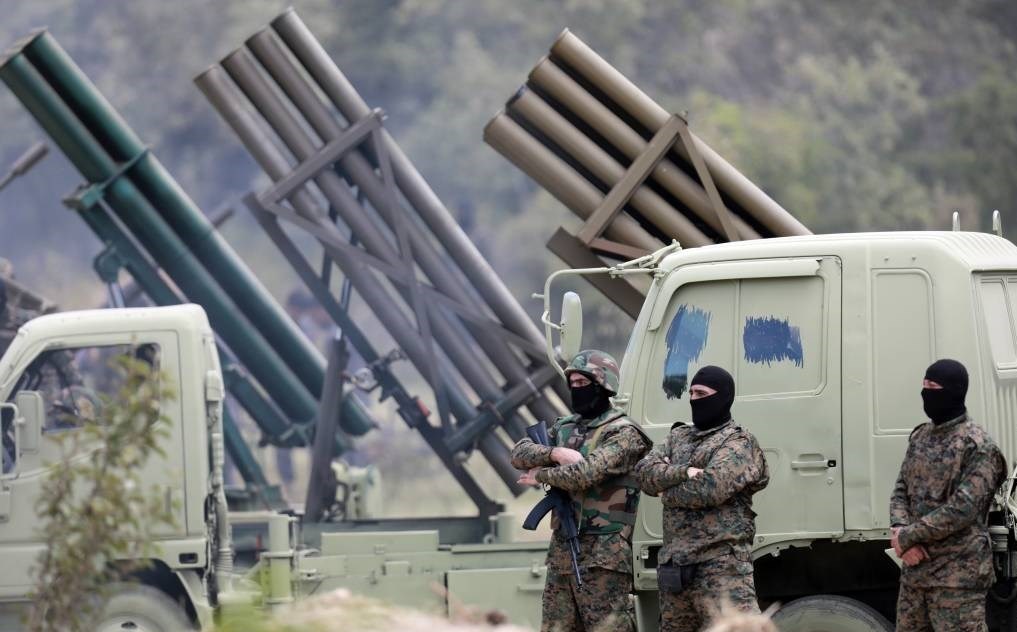
Hezbollah Intensifies Cross-Border Strikes With Guided Rockets, FPV Drones
On 15 May, Hezbollah released footage of multiple attacks against Israeli positions near the Lebanon-Israel border, including guided rocket launches near Nahariyya and FPV drone strikes on vehicles and a Merkava tank. The incidents occurred in northern Israel and southern Lebanon in the early morning hours.
Key Takeaways
- In the early hours of 15 May 2026, Hezbollah published footage showing four rockets launched at an Israeli military base near Nahariyya, northern Israel, including two guided "Nasr‑2" rockets.
- Additional Hezbollah footage from around the same timeframe depicted several FPV drone strikes against Israeli military vehicles and a Merkava tank near the Israel‑Lebanon border and in the town of Aainata, southern Lebanon.
- Israeli air defences reportedly intercepted only one of the four rockets, with the others falling in what Israel termed "open areas," though guided munitions may have struck or closely approached military targets.
- The attacks coincide with reports of explosions and at least one Iron Dome interception attempt near Tiberias and Eilabun in northern Israel.
- These actions underline an ongoing low‑intensity but technologically sophisticated confrontation along the Israel‑Lebanon frontier.
Around 04:20–05:02 UTC on 15 May 2026, Hezbollah publicised a series of attacks against Israeli targets along the northern front. Footage released by the group shows the launch of four rockets toward an Israeli military base near Nahariyya, on Israel’s northern coast. Notably, two of the rockets were identified as "Nasr‑2" guided rockets, indicating a higher degree of accuracy compared to standard unguided projectiles.
Israeli sources stated that one rocket was intercepted by air defences, while the remaining three fell in "open areas." However, given that half of the salvo consisted of guided munitions, there is a non‑trivial possibility that at least some rockets impacted close to or on intended military targets, even if casualties or significant damage have not yet been confirmed.
In parallel, Hezbollah released additional footage around 05:02 UTC depicting multiple FPV (first‑person‑view) drone strikes against Israeli military assets along the border. One video shows an FPV drone hitting a van transporting Israeli soldiers to a frontline position. Other sequences show drone strikes against several vehicles, including an Israeli Merkava tank in or near the town of Aainata in southern Lebanon, resulting in visible fires and destroyed equipment.
Background & Context
Since the onset of the wider regional escalation, Hezbollah and Israel have engaged in near‑daily exchanges of fire along the Lebanon‑Israel border, ranging from sniper fire and mortar shells to guided missiles and drone attacks. Hezbollah has increasingly showcased its precision capabilities, including anti‑tank guided missiles and guided rockets, while also adopting FPV drones for targeted strikes against individual vehicles and small units.
Israel, for its part, has relied on a mix of air strikes, artillery, and drone operations to target Hezbollah launch sites, observation posts, and infrastructure in southern Lebanon. Both sides have aimed to calibrate their actions to avoid a slide into full‑scale war, though the technological sophistication of attacks has gradually increased.
Key Players Involved
Hezbollah’s rocket and drone units are central to these operations, drawing on Iranian‑supplied or locally adapted systems. The use of Nasr‑2 guided rockets and FPV drones underscores the group’s growing precision and unmanned capabilities.
On the Israeli side, the Israel Defense Forces (IDF) Northern Command, air defence units (including Iron Dome batteries), and armoured and infantry units deployed along the border are the primary actors. The IDF confirmed the death of a soldier in Lebanon—20‑year‑old Staff Sergeant Negev Dagan—around 04:21 UTC, underscoring the lethal nature of the ongoing exchanges.
Why It Matters
The combination of guided rockets and FPV drones represents a qualitative evolution in the cross‑border conflict. Guided rockets offer Hezbollah the ability to threaten specific military installations and infrastructure, while FPV drones enable highly targeted strikes on vehicles and small formations, potentially bypassing some traditional air defences.
For Israel, this increases the risk to forward‑deployed units, logistics convoys, and fixed installations even in areas previously considered relatively secure. The footage of an FPV drone striking a Merkava tank is particularly symbolic, as it challenges perceptions of the tank’s survivability in the face of cheap, precise loitering munitions.
The reported Iron Dome interceptions near Tiberias and Eilabun and explosions in northern Israel reflect ongoing rocket threats deeper into the country, which carry both military and psychological weight for the civilian population.
Regional and Global Implications
Regionally, the steady escalation in capabilities along the Israel‑Lebanon border raises the risk of miscalculation. As Hezbollah demonstrates more accurate and persistent strike options, Israel may feel compelled to undertake more forceful pre‑emptive or retaliatory operations in southern Lebanon, which could in turn trigger broader confrontation.
Further, Hezbollah’s effective use of guided rockets and FPV drones serves as a proof‑of‑concept for other non‑state or proxy actors in the region, potentially accelerating the diffusion of such systems and tactics. This could alter the military balance in multiple theatres where state adversaries rely heavily on armoured units and fixed infrastructure.
Outlook & Way Forward
In the short term, both sides are likely to continue their pattern of calibrated strikes. Hezbollah can be expected to publicise successful FPV and guided rocket attacks to bolster deterrence and domestic standing, while carefully managing escalation thresholds. Israel will likely review force protection measures for its border units, reinforcing air defences and investing further in counter‑UAS technologies and tactics.
Observers should monitor whether Israel responds to these latest attacks with expanded airstrikes beyond the immediate launch areas or leadership‑level targets within Hezbollah. Any significant Israeli move against high‑value Hezbollah assets or command centres could prompt a wider rocket response reaching deeper into Israel.
Longer term, the increasing normalisation of guided rockets and FPV drones in this theatre suggests that the northern front will remain a zone of persistent low‑intensity but high‑technology conflict. Diplomatic efforts to de‑escalate are likely to face growing challenges as both sides perceive tactical benefits from continued limited engagement. The risk of a misjudged strike causing mass casualties, thereby triggering a broader war, will remain a central concern for regional stability.
Sources
- OSINT