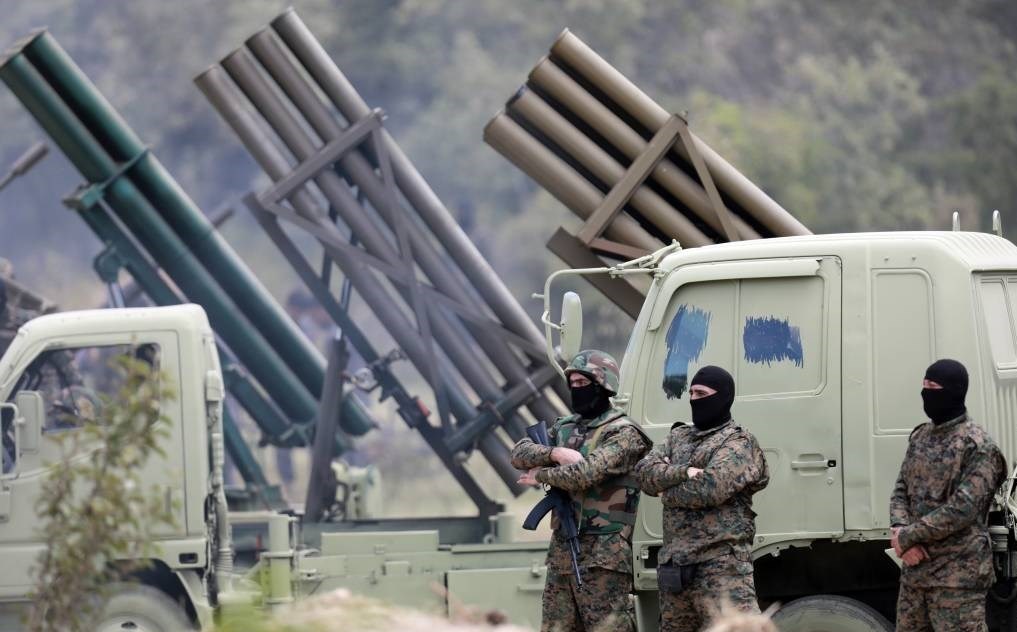
Hezbollah Intensifies Cross-Border Strikes on Northern Israel
On 15 May 2026, Hezbollah released footage of multiple attacks on Israeli targets near the Lebanon-Israel border, including guided rocket launches near Nahariyya and FPV drone strikes on vehicles and a Merkava tank. Israeli air defenses conducted at least one interception near Tiberias as explosions were heard across northern Israel.
Key Takeaways
- Hezbollah publicized the launch of four rockets, including two "Nasr-2" guided rockets, toward an Israeli base near Nahariyya on 15 May.
- The group also released footage of several FPV drone strikes on Israeli military vehicles and a Merkava tank near the Lebanon-Israel frontier.
- Explosions and interception attempts were reported around 04:02–04:04 UTC in northern Israel, including near Tiberias and Eilabun.
- The Israeli military confirmed the death of a 20-year-old soldier in Lebanon, underscoring ongoing ground and cross-border engagements.
- The incidents highlight an escalation in the quality and visibility of Hezbollah’s precision and drone capabilities against Israel.
In the early hours of 15 May 2026, a series of developments along the Lebanon-Israel border underscored a slow but steady escalation in the confrontation between Hezbollah and Israel. Around 04:20–05:02 UTC, Hezbollah published footage showing the launch of four rockets toward an Israeli military base near Nahariyya in northern Israel. Notably, two of the rockets were identified as "Nasr-2" guided rockets, indicating an emphasis on more accurate stand-off munitions.
Simultaneously, Hezbollah released additional footage depicting first-person-view (FPV) drone attacks against Israeli military targets. These clips included strikes on vehicles, a van reportedly transporting Israeli soldiers to a frontline position, and a Merkava tank in the town of Aainata in southern Lebanon. Although detailed casualty figures were not provided, visual confirmation of multiple successful impacts suggests a growing threat to Israeli ground forces from small, low-cost, precision drones.
Around the same time frame, residents in northern Israel reported explosions and air defense activity. At approximately 04:02–04:04 UTC, at least one Iron Dome interception attempt was noted near Tiberias, and possible interceptions were reported near Eilabun, with explosions heard in the area. These events are consistent with the cross-border rocket fire claimed by Hezbollah and indicate ongoing efforts by Israeli air defenses to mitigate the threat.
The Israel Defense Forces (IDF) later announced the death of Staff Sergeant Negev Dagan, a 20-year-old soldier, in Lebanon. While details of the incident were not specified, his death underscores that Israeli forces are actively engaged in operations on or near Lebanese territory, likely in efforts to disrupt Hezbollah firing positions, observation posts, and logistics nodes.
Hezbollah’s decision to publicize detailed footage of both rocket and FPV strikes is tactically and strategically significant. It serves as proof-of-capability to domestic and regional audiences, signaling that the group can hit specific military assets and possibly penetrate Israeli armored protection. The use of guided rockets such as the Nasr-2 also reflects Iran-backed efforts to enhance the precision of Hezbollah’s arsenal, moving beyond indiscriminate area bombardment.
For Israel, these developments pose operational and political challenges. Tactically, the IDF must adapt to a battlespace in which armored vehicles and troop transports are highly vulnerable to cheap, expendable drones capable of evading some traditional detection systems. Strategically, sustained cross-border attacks increase pressure on the Israeli government to either escalate militarily in Lebanon or accept a protracted low-intensity conflict along its northern border.
Regionally, the intensification of Hezbollah-Israel exchanges risks spillover effects into neighboring states and maritime domains, particularly if precision weapons begin targeting critical infrastructure or population centers. The potential for miscalculation also rises as both sides balance domestic pressure, alliance obligations, and their broader positions regarding conflicts in Gaza and Syria.
Internationally, these incidents will be watched closely by states concerned about escalation between Israel and Iran’s regional partners. The visible use of FPV drones and guided rockets contributes to a growing global case study on how non-state actors integrate precision strike technologies, potentially informing future conflicts elsewhere.
Outlook & Way Forward
In the near term, Israel is likely to respond with targeted strikes against Hezbollah positions, weapons depots, and command nodes in southern Lebanon, while seeking to avoid uncontrolled escalation into a full-scale war. Expect continued use of airpower, artillery, and possibly special operations forces to degrade Hezbollah’s rocket and drone infrastructure. The IDF will also prioritize counter-drone measures, including electronic warfare and rapid sensor-shooter loops.
Hezbollah, for its part, is likely to maintain a calibrated campaign of harassment and demonstration attacks—enough to signal deterrence and solidarity with other fronts, but not so intense as to provoke a decisive Israeli ground offensive. The group will continue to showcase video evidence of successful strikes to reinforce its deterrence narrative.
Analysts should monitor shifts in the frequency and precision of cross-border fire, Israeli statements about red lines, and any direct references to Iranian involvement in the provision of guided munitions or drone systems. A significant strike causing mass casualties on either side, or an attack on high-value infrastructure, could rapidly alter the conflict trajectory and draw in broader regional and international actors seeking to broker de-escalation.
Sources
- OSINT