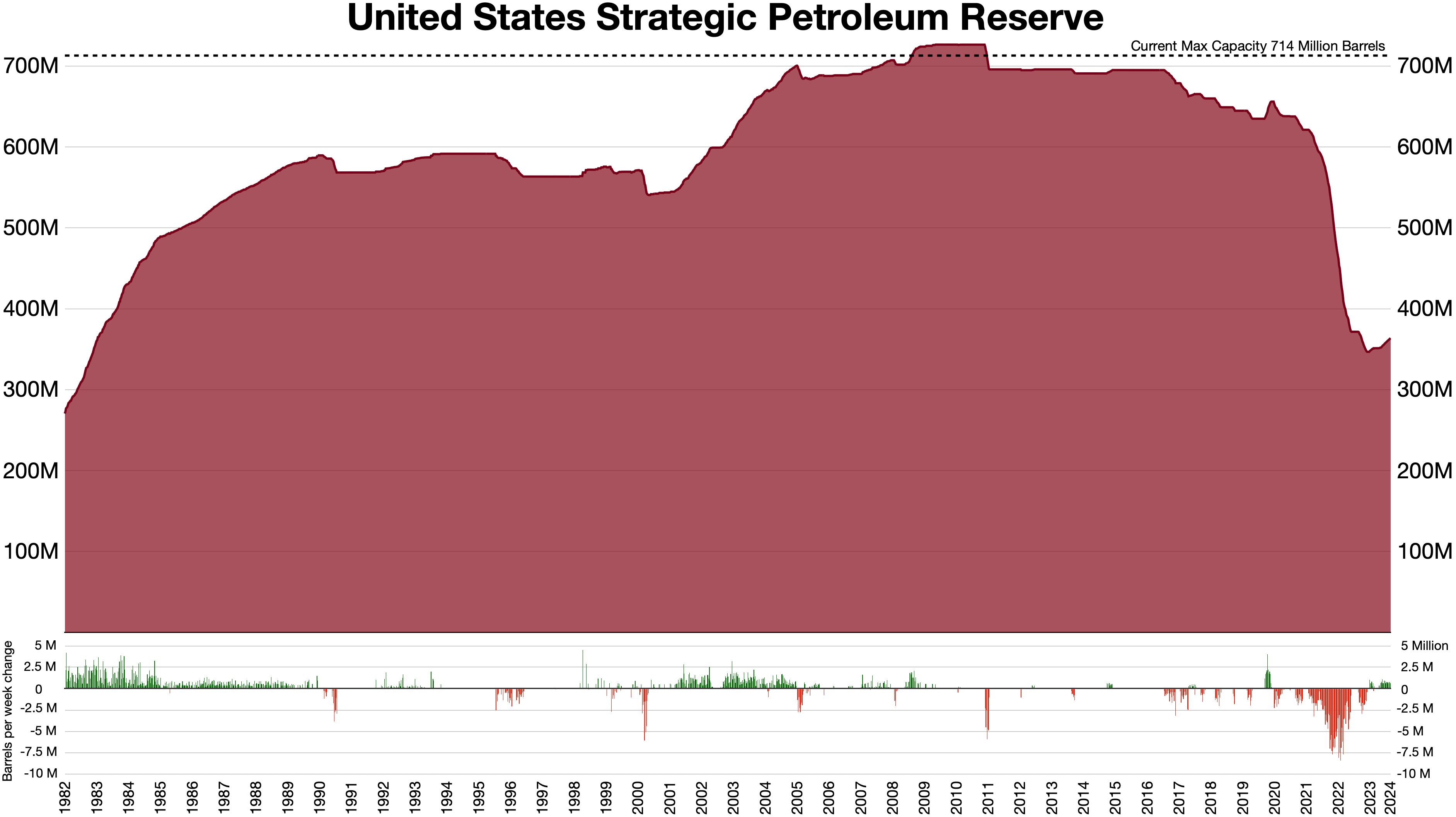
U.S. Strategic Petroleum Reserve Drops to Lowest Level Since 1983, Weakening Washington’s Oil Shock Cushion
The U.S. Strategic Petroleum Reserve has fallen to its lowest level in more than four decades, even as conflict threatens shipping near the Strait of Hormuz and tensions with Iran intensify. The drawdown leaves Washington with a thinner buffer against supply shocks and complicates any decision to use oil as a tool in future crises.
America’s last‑resort oil stockpile is now thinner than it has been in a generation. As of 21 July, the U.S. Strategic Petroleum Reserve (SPR) has fallen to its lowest level since 1983, shrinking the cushion Washington can lean on if global crude supplies are suddenly disrupted or weaponized.
The SPR, a network of underground salt caverns along the Gulf Coast, was created to shield the U.S. economy from severe supply shocks, whether from wars, embargoes or natural disasters. Precise inventory figures were not detailed in the latest reports, but the benchmark—that storage is now at a four‑decade low—is significant in itself. It means that each million barrels released in a future crisis will represent a larger share of a smaller reserve.
On paper, today’s United States is less vulnerable to foreign oil disruptions than it was in 1983, thanks to a boom in domestic production and a more diversified global supply web. But exposure has not disappeared; it has shifted. The U.S. remains tied into global pricing, and a major disruption in a chokepoint like the Strait of Hormuz, where mutual U.S.–Iran strikes have already put tankers at risk, would still send shockwaves through gasoline prices, inflation and political sentiment at home.
For households and businesses, the SPR level is invisible until it isn’t. When pumps run dry after a hurricane or prices spike during a geopolitical crisis, emergency releases can help blunt the worst of the shock. A smaller reserve narrows that margin. It also reduces Washington’s ability to calm markets simply by signalling that it can and will put extra crude on the water if needed; credibility depends not only on willingness, but on volume.
Strategically, the drawdown constrains U.S. options at a moment when energy is once again entangled with security tensions in the Middle East, Russia’s war in Ukraine, and competition with China. Using the SPR to manage domestic prices in peacetime or during moderate disruptions may feel attractive politically, but it leaves less capacity to respond if several crises overlap—say, an extended outage in the Gulf, new sanctions pressure on a major producer, and hurricane damage in the Gulf of Mexico.
The timing is particularly delicate given Iran‑linked threats to shipping near Hormuz and claims of strikes on U.S.-linked infrastructure in the Gulf. If tanker flows were substantially interrupted, Washington might face an unpalatable set of choices: deploy part of a diminished reserve to support allies and cool markets, or hold back and risk a sharper economic hit at home. Either course would be harder to defend politically than if cavern levels were closer to their historical norms.
For major importers in Europe and Asia, a thinner U.S. reserve is another reason to revisit their own emergency stockpiles and diversification plans. While the International Energy Agency coordinates collective responses to supply emergencies, the effectiveness of that system depends heavily on U.S. capacity and leadership. A less well‑stocked America may be less willing—or less able—to lead large, sustained releases.
The signals to watch now include upcoming U.S. government reports on SPR refill plans, any new authorizations for releases tied to price management rather than acute disruption, and how oil futures markets price in the combination of low reserves and elevated geopolitical risk. If conflict around key maritime chokepoints intensifies while the SPR remains near its current lows, energy security will move from a background concern to a central test of U.S. crisis management.
Sources
- OSINT