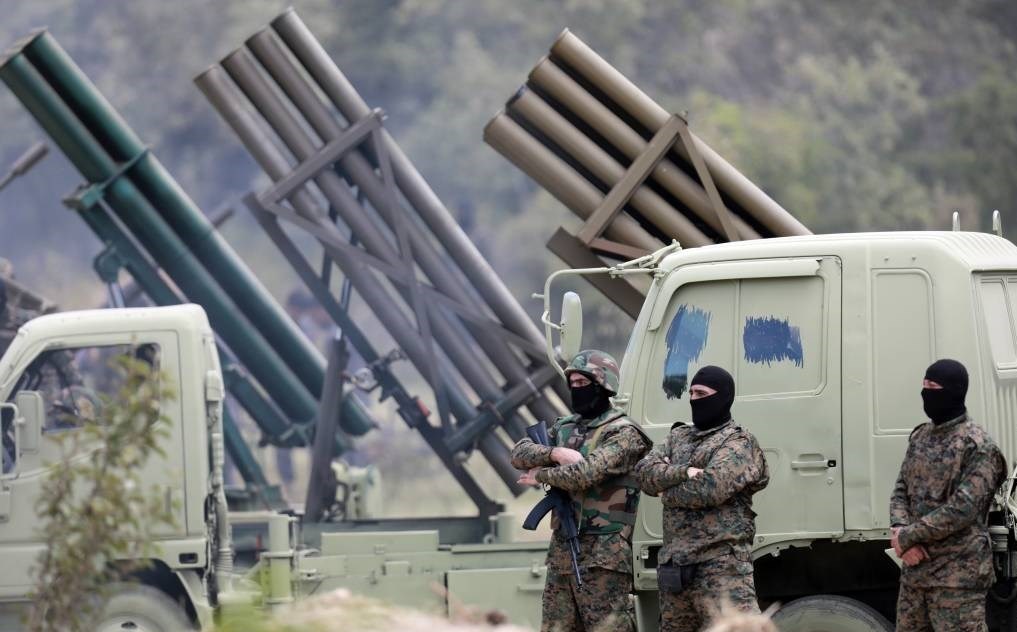
Hezbollah, Gaza Militants Step Up Attacks On Israeli Forces
On 10 May 2026, militant groups on two fronts targeted Israeli forces with drones and small arms. Around 15:00 UTC, the “Deterrent... Field Force” claimed an ambush that killed three members of IDF‑backed militias in Khan Younis, while Hezbollah’s FPV drone strike hit IDF soldiers at a helipad in Shlomi, northern Israel.
Key Takeaways
- On 10 May 2026, the “Deterrent... Field Force” in Gaza claimed an ambush killing three fighters from IDF‑backed militias in Khan Younis.
- The group’s fighters were documented using AKM rifles and small arms in close‑range engagements.
- The same day, Hezbollah carried out an FPV drone strike on IDF soldiers at a helipad in Shlomi, northern Israel.
- These concurrent attacks from Gaza and Lebanon highlight Israel’s multi‑front security challenges.
- Militant use of drones and ambush tactics complicates Israeli efforts to secure occupied and contested areas.
On 10 May 2026, Israeli forces faced coordinated pressure from armed groups operating in both the Gaza Strip and southern Lebanon. Around 15:00 UTC, reports from Khan Younis in southern Gaza indicated that a militant formation styling itself as the “Deterrent... Field Force” conducted an ambush against local forces aligned with the Israel Defense Forces. The unit claimed to have killed three members of an IDF‑backed militia operating in the area.
Imagery associated with the claim shows at least one fighter armed with a 7.62x39mm AKM assault rifle equipped with railed handguards, suggesting an emphasis on updated small‑arms ergonomics and potential for accessories such as optics or lights. The engagement appears to have been a short‑range encounter, indicative of ongoing close‑quarters fighting in urban or semi‑urban terrain in and around Khan Younis, where Israeli forces and allied units are attempting to suppress residual militant presence.
The same day, as noted in separate reporting around 15:00–16:01 UTC, Hezbollah executed a first‑person‑view (FPV) kamikaze drone strike on Israeli soldiers gathered at a helicopter landing area in Shlomi, near Israel’s northern border. This attack used a fiber‑optic guided drone armed with a PG‑7(L) warhead, demonstrating significant sophistication in both payload selection and control links designed to resist jamming.
Taken together, these incidents underscore the multi‑front nature of Israel’s current security posture. In Gaza, even in areas where Israel has exerted sustained military pressure, locally rooted militant groups retain the capacity to conduct lethal ambushes against partner forces and, where possible, IDF units. In the north, Hezbollah continues to exploit drones to inflict casualties and erode the perception of Israeli control near the border.
Key actors include the IDF and its allied militias in Gaza, the Gaza‑based “Deterrent... Field Force,” and Hezbollah’s military wing in Lebanon. On the Israeli side, the government and military leadership must allocate finite ISR and air defense resources across both theaters while managing domestic expectations about security and casualty levels.
These developments matter because they reveal how non‑state actors are adapting to Israel’s conventional superiority by favoring asymmetric tactics and low‑signature operations. In Gaza, ambushes by small groups with light weapons can limit the effectiveness of armored patrols and complicate attempts to transition to a lower‑intensity occupation or security presence. In the north, Hezbollah’s ability to strike IDF personnel with drones at staging and logistics points shows that rear areas are increasingly vulnerable.
The cumulative effect is to stretch Israeli forces and prolong instability in both arenas, while also serving the strategic narratives of these groups. For Gaza militants, successful attacks support claims of ongoing resistance despite extensive destruction. For Hezbollah, visible hits on Israeli troops reinforce its deterrent posture and messaging to domestic and regional audiences.
Outlook & Way Forward
In the short term, expect Israeli forces to intensify counter‑insurgency measures in Khan Younis and other parts of Gaza where IDF‑backed militias operate. This may include more aggressive raids, expanded intelligence operations to identify militant cells, and tighter control of movement in and out of contested neighborhoods. The reliance on local auxiliary forces exposes Israel to targeted violence and raises questions about the sustainability and reliability of such partnerships.
On the northern front, Israel is likely to increase emphasis on counter‑drone defenses at forward bases, helipads, and troop concentrations. Additional passive measures—such as stricter dispersion of personnel, hardened shelters and camouflage—will complement technical solutions. Nevertheless, as long as Hezbollah retains access to a diverse inventory of drones and munitions, it will seek to maintain pressure through intermittent, high‑visibility strikes.
Strategically, these multi‑front attacks complicate any Israeli effort to declare clear victory or transition to a stable security architecture in either Gaza or along the Lebanon border. International mediators may push for renewed or revised ceasefire arrangements that explicitly address drone use and local militia activity, but implementation will be challenging given the number of actors and the depth of grievances involved. Analysts should monitor casualty trends among IDF‑aligned militias in Gaza, changes in Hezbollah’s targeting patterns, and domestic political reactions inside Israel to gauge whether the government will double down on military solutions or explore more robust political arrangements.
Sources
- OSINT