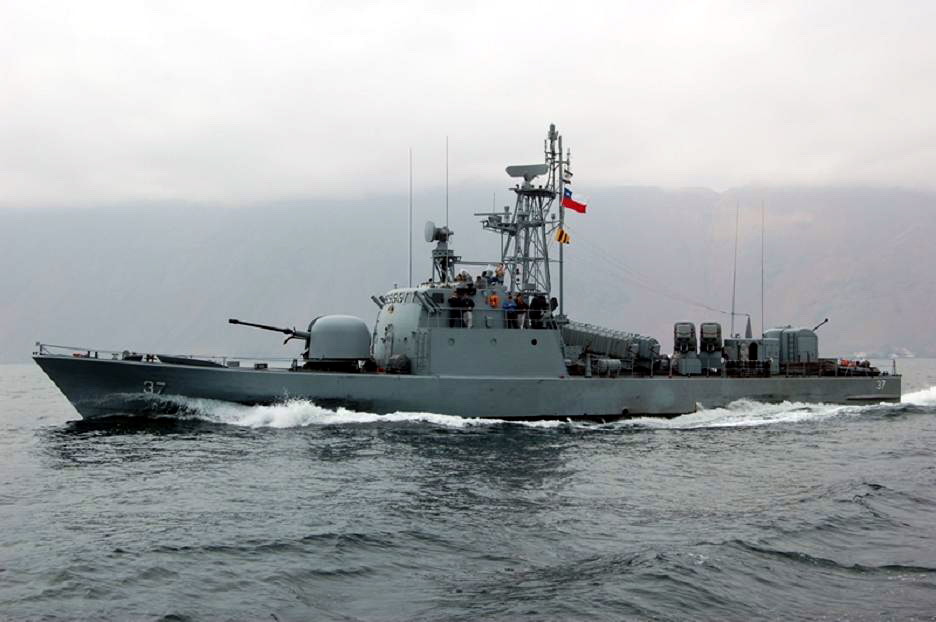
Iran Unveils Missile Fast-Attack Boat, Sharpening Gulf Swarm Threat to Warships
Severity: WARNING
Detected: 2026-05-30T22:11:08.088Z
Summary
Reports at 22:00 UTC say Iran’s IRGC has rolled out a new ‘27 Rajab’ missile fast attack boat, advertised to carry two 700 km-range cruise missiles and to operate in rougher seas than earlier craft. The move marginally lifts the threat envelope around U.S. and Gulf assets and could deepen market anxiety over energy flows through the Persian Gulf and Strait of Hormuz.
Details
Iran’s Islamic Revolutionary Guard Corps has publicly unveiled a new missile-armed fast attack boat, the ‘27 Rajab’, at roughly 22:00 UTC, explicitly presented as part of its asymmetric “mosquito fleet” designed to swarm and threaten larger warships in the Persian Gulf and approaches to the Strait of Hormuz. Open-source reporting describes a sleek, low-profile trimaran or catamaran hull carrying two cruise missiles with a claimed 700 km range and the ability to operate in 3‑meter seas—an incremental but meaningful improvement over earlier small-boat designs.
Confirmed details are limited to the public unveiling and Iranian performance claims; independent technical verification is not yet available. Still, the advertised range would allow the platform, if real and fully integrated, to hold at risk not only surface combatants but also shore infrastructure, offshore platforms, and staging areas from deep within Iranian littorals. The craft fits Iran’s longstanding strategy of saturating confined waters like the Gulf with numerous, relatively cheap attack boats rather than matching U.S. or Gulf navies ship-for-ship in blue-water combatants.
For tanker crews, port operators, and insurers, this is one more data point that shifts risk calculations. Even if the ‘27 Rajab’ class is initially fielded in small numbers, its presence complicates threat assessment for commercial vessels transiting close to Iranian waters or hugging coastal shipping lanes to avoid other hazards. Governments in Riyadh, Abu Dhabi, Doha, and Muscat now face fresh pressure to refine naval escort doctrines, surveillance coverage, and deconfliction arrangements with U.S. forces to counter a more diverse Iranian small-boat inventory.
Militarily, this development marginally thickens Iran’s maritime A2/AD (anti-access/area denial) posture. A low-observable, high-speed, missile‑equipped fast attack craft is harder to track and neutralize than fixed coastal batteries and more disposable, and more numerous, than major surface vessels. If the IRGC proliferates this design across its Gulf bases and potentially to proxy forces, U.S. and allied forces will need to allocate additional ISR, air cover, and missile-defense resources to defend high‑value units and chokepoints.
For markets, the announcement reinforces a narrative of rising latent risk to the 20% of global crude and significant LNG volumes that move through the Strait of Hormuz. While today’s unveiling alone is unlikely to trigger a sharp price move absent immediate follow-on incidents, it supports a higher geopolitical risk premium baked into Brent and Dubai benchmarks and pressures marine war-risk insurance pricing. Energy equities with exposure to Gulf production and tanker operators could see incremental volatility if investors extrapolate from this capability signal to a higher probability of future harassment, interdiction, or miscalculation at sea.
Over the next 24–48 hours, watch for: (1) satellite or OSINT imagery confirming basing locations and numbers of ‘27 Rajab’ hulls; (2) U.S. Central Command or Gulf state navy statements adjusting posture, escorts, or rules of engagement; and (3) any sign that these craft are deployed closer to the Strait of Hormuz shipping lanes. A confirmed deployment pattern—rather than a one‑off unveiling—would be the trigger for more pronounced market repricing and higher alerting on physical oil and LNG flows.
MARKET IMPACT ASSESSMENT: Incremental upward pressure on crude and tanker insurance premia as investors reassess Iran’s capacity to threaten warships and energy infrastructure in and around the Strait of Hormuz; modest safe-haven bids for gold and USD possible if further IRGC naval deployments follow.
Sources
- OSINT