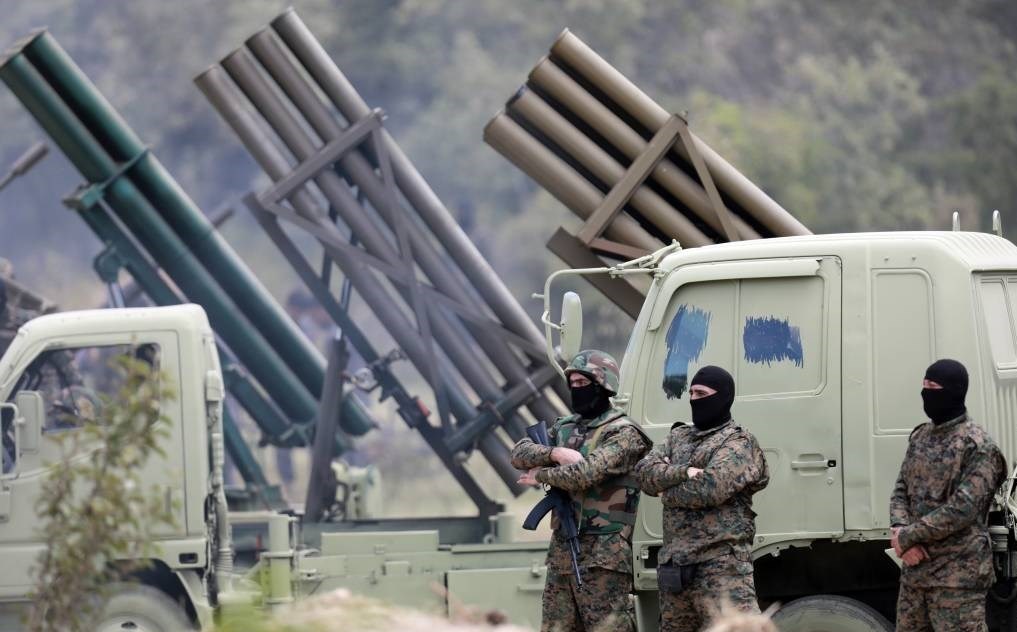
Reports: Hezbollah Rockets Hit Kiryat Shmona, Target Israeli Iron Dome Launchers
Severity: WARNING
Detected: 2026-05-30T04:10:38.199Z
Summary
Hezbollah rockets struck the northern Israeli city of Kiryat Shmona around 04:04 UTC, with observers saying the group is increasingly aiming at Iron Dome launchers rather than solely border-area military posts. A sustained campaign to degrade Israel’s air defenses near civilian centers would widen the conflict’s reach into northern Israel and raise the odds of a larger Israeli response into Lebanon.
Details
Hezbollah rocket fire hit the Israeli city of Kiryat Shmona early 30 May, with OSINT accounts reporting the likely use of 122mm 9M22U “Grad” pattern artillery rockets and noting a recent pattern of deliberate strikes on Iron Dome air-defense launchers. The attack took place shortly after 04:00 UTC and represents a continuation and sharpening of Hezbollah’s campaign against northern Israel, now pairing urban targeting with efforts to erode Israel’s protective shield over those same areas.
Available reporting indicates impacts in or near Kiryat Shmona, a key population center in Israel’s far north, but casualty and damage figures were not provided in the initial posts. The technical assessment of 122mm Grad-type munitions is consistent with Hezbollah’s known arsenal. Claims that Iron Dome launchers are being specifically hunted reflect repeated recent salvos aimed near known battery positions; this pattern has been corroborated by multiple independent conflict trackers but not officially confirmed by the Israel Defense Forces.
For residents of Kiryat Shmona and the broader Galilee, the shift from sporadic border fire to frequent, targeted salvos at both urban areas and air-defense sites increases the probability of successful penetrations of Israel’s missile shield. That raises direct risk to housing, schools, and local business infrastructure and could spur further internal displacement from the north. On the Lebanese side, Israeli counter-battery and air operations will likely intensify, deepening civilian exposure in the belt of villages used as launch zones and complicating already fragile local economies.
Militarily, systematic targeting of Iron Dome launchers is a significant tactical development. Even partial attrition or forced relocation of batteries around the northern front would degrade interception coverage, free up corridors for heavier or more precise munitions, and strain Israel’s finite interceptor stockpiles. If Hezbollah can create gaps in the shield over northern Israel, it could later pair bulk rocket fire with higher-value precision-guided systems or anti-ship missiles, raising risk not only to cities but also to critical infrastructure and military bases inland and on the coast.
For markets, this is a second-order signal rather than an immediate shock. However, investors closely track whether northern Israel-Lebanon exchanges stay bounded or move toward a more open confrontation that draws in Iran or triggers sustained Israeli operations deep in Lebanon. Any perception that the northern front is sliding toward a larger war would bolster crude prices via elevated Middle East risk premia, support gold and other safe havens, and weigh modestly on regional equities and tourism-linked names in Israel and Lebanon. Insurers exposed to Israeli and Lebanese property and infrastructure risk may start to reassess pricing if rocket accuracy and Iron Dome suppression attempts improve.
Over the next 24–48 hours, key indicators will be: (1) whether Israel announces the destruction of specific Hezbollah rocket units or Iron Dome-targeting cells; (2) any public confirmation that Iron Dome launchers or associated radars have been damaged or forced to relocate; (3) a measurable increase in successful rocket penetrations into Kiryat Shmona or deeper urban areas; and (4) Lebanese or Iranian political messaging that either claims credit and escalatory intent or, conversely, signals a desire to keep the confrontation below full-scale war. A major Israeli strike package into Lebanon’s interior, or Hezbollah use of heavier rockets or precision systems in follow-on attacks, would move this toward a higher-risk scenario for both regional security and energy markets.
MARKET IMPACT ASSESSMENT: Modest upward pressure on oil and safe-haven assets if escalation persists; traders will watch for Israeli retaliation in Lebanon or any spillover involving Iran that could revive concerns around Eastern Med gas and broader Middle East risk.
Sources
- OSINT